


Call us: 07450 483941

The horsebox licence question decides which box you can drive, so it’s worth getting right before you book. The short version is simple: 3.5t on a car licence, up to 7.5t with C1.
However, the details trip people up. Pre-1997 entitlement, plated weights, payload and trailers all cause confusion, and getting it wrong can leave you uninsured.
This guide explains the UK rules in plain English, based on current DVLA guidance. It also shows you how to check exactly what your licence covers.
Horsebox licence basics: it’s all about plated weight
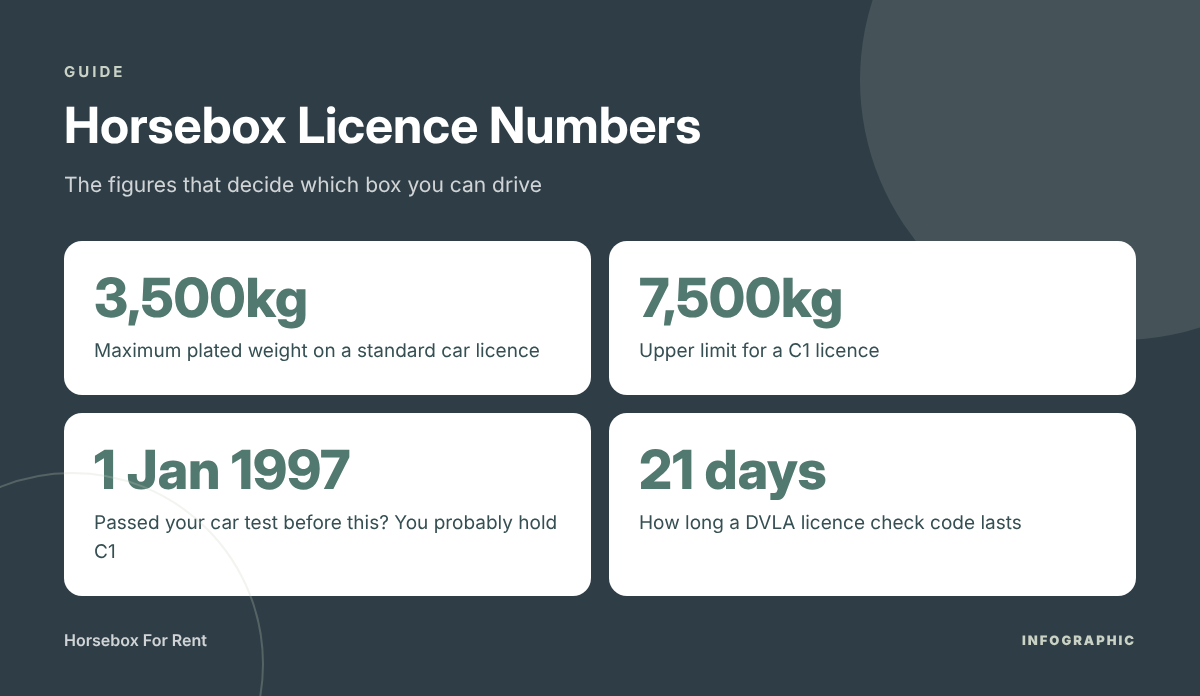
Your licence is based on the vehicle’s maximum authorised mass, or MAM. That’s the most the vehicle is allowed to weigh fully loaded, and it’s shown on the vehicle’s weight plate.
It’s not what the box actually weighs on the day. So a 7.5t lorry that’s nearly empty still needs a C1 licence, because its plated weight is 7,500kg.
Three weights worth knowing
- Maximum authorised mass (MAM). The plated weight. This decides the licence.
- Unladen weight. What the empty box weighs, including fuel.
- Payload. The difference between the two. Horses, tack, water, feed and passengers all come out of it.
In short, the plate decides your horsebox licence, and the payload decides how much you can carry.
The categories at a glance
Here is how the main UK licence categories apply to horseboxes. The full definitions are on GOV.UK’s driving licence categories page.
| Category | What it covers | Typical horsebox | Minimum age | How most people get it |
|---|---|---|---|---|
| B | Vehicles up to 3,500kg MAM | 3.5t horsebox | 17 | Standard car test |
| C1 | Vehicles from 3,500kg to 7,500kg MAM, with a trailer up to 750kg | 5t and 7.5t horseboxes | 18 | Car test passed before 1997, or a separate C1 test |
| C1E | A C1 vehicle towing a trailer over 750kg, up to 12,000kg combined | A 7.5t box towing a trailer | 18 | C1 first, then a C1E test; pre-1997 holders have a restricted version |
| C | Vehicles over 7,500kg | Large horse lorries | Check GOV.UK | Full lorry licence and tests |
So for most riders, the decision comes down to B or C1. C1E matters only if you plan to tow behind a larger box.
Category B: driving a 3.5t horsebox on a car licence
A standard car licence lets you drive vehicles with a MAM of up to 3,500kg. That includes 3.5t horseboxes, which is why they’re so popular.
Our 3.5t boxes can be driven on a standard category B licence. They suit one or two horses and feel much like driving a large van.
Watch the payload
The weakness of a 3.5t box is payload. Two big horses, tack, water and passengers can push it close to, or over, its plated weight.
Overloading is an offence in its own right, whatever licence you hold. It also makes the box brake and handle worse, so tell us your horses’ sizes when you book.
Re-plated boxes
Some boxes have been re-plated to a lower weight, so they can be driven on a car licence. That’s legal, but it often leaves very little payload. Always check the actual figure.
What about trailers?
Since December 2021, drivers who passed a car test can tow trailers up to 3,500kg MAM without a separate trailer test. That’s useful for horse trailers behind a car, but it doesn’t change the rules for driving a horsebox.
Category C1: the horsebox licence for 5t and 7.5t boxes
C1 covers vehicles with a MAM between 3,500kg and 7,500kg. Our 5t and 7.5t boxes need C1 entitlement.
There are two common routes to holding it.
If you passed your car test before 1 January 1997
Most drivers who passed their car test before 1 January 1997 already have C1 on their licence. This is often called “grandfather rights”.
Check your licence rather than assuming, though. It takes two minutes, and it’s exactly what any hire firm will check too.
If you passed from 1997 onwards
You’ll need to add C1 by taking separate tests. In outline, the process is:
- Apply for provisional C1 entitlement, which includes a medical examination.
- Pass the lorry theory test, with multiple-choice and hazard perception parts.
- Take training with an instructor who teaches C1.
- Pass the C1 practical driving test.
If you only drive your own horsebox for leisure, you usually won’t need the Driver CPC qualification that professional drivers hold. GOV.UK’s guidance on becoming a lorry driver explains the steps and any exemptions in full.
Is C1 worth getting?
If you only need a bigger box once or twice a year, probably not. A 3.5t box, or two trips, usually does the job.
However, if you regularly move two or more large horses, or you want more room for kit, C1 opens up a much wider choice of boxes. Training costs and waiting times for tests vary, so get several quotes before you start.
Keeping C1 as you get older
Drivers keep their pre-1997 C1 entitlement after 70 only if they meet the higher medical standards for lorry drivers. That means a medical report at each renewal. If you passed a C1 test, renewals and medicals follow the lorry licence cycle set out on GOV.UK.
Not sure which box suits your licence?
Tell us what’s on your licence and how many horses you’re moving. Our 3.5t boxes drive on a car licence, and our 5t and 7.5t boxes need C1. Call or WhatsApp 07450 483941.
Category C1E: towing behind a larger box
C1E lets you drive a C1 vehicle towing a trailer over 750kg, as long as the combined MAM doesn’t exceed 12,000kg. It also covers a car-sized vehicle towing a very heavy trailer within that same combined limit.
For most horsebox drivers, it rarely matters. You’d only need it to tow something heavy, such as a trailer, behind a 5t or 7.5t box.
Pre-1997 C1E
Drivers with pre-1997 entitlement usually hold a restricted C1E. On the licence, it carries code 107, which limits the combined weight to 8,250kg.
In practice, that means a 7.5t box could tow only a very light trailer. So if towing is part of your plan, check the figures carefully.
How to check your horsebox licence entitlement
Don’t rely on memory. Checking takes two minutes and removes all doubt.
- Online. Use the GOV.UK View your driving licence service. It shows every category you hold, plus any restriction codes.
- On your photocard. The back lists each category with its dates. Look for C1, C1E and any codes beside them.
- Old paper licences. These can still be valid, but categories are harder to read. Checking online is quickest.
The licence check code
Hire firms often ask for a check code, which you generate through the same GOV.UK service. Each code lasts 21 days. So create it close to your hire date, not weeks ahead.
Northern Ireland licences
If your licence was issued in Northern Ireland, it’s handled by the DVA rather than the DVLA. The categories are broadly the same, but use the DVA’s own checking service.
What happens if you drive without the right licence?
Driving a box that your licence doesn’t cover is an offence. It can lead to penalty points and a fine.
More importantly, your insurance is unlikely to be valid. If there’s an accident, you could be personally liable for the damage, with a horse on board and nothing covering you.
That’s why every good hire firm checks licences before handover. It protects you, your horse and other road users.
Insurer rules on top of the law
Hire insurers may also set their own conditions, such as a minimum age or years of driving experience. These sit on top of the DVLA rules, so ask before you book.
Choosing the right box for your licence
Once you know your horsebox licence entitlement, choosing a box is straightforward.
| Your licence | Boxes you can drive | Good for |
|---|---|---|
| Car licence passed from 1997 onwards | 3.5t | One or two horses, shorter trips, easy parking |
| Car licence passed before 1997 (with C1) | 3.5t, 5t and 7.5t | Two or more horses, more kit, longer trips |
| C1 test passed separately | 3.5t, 5t and 7.5t | As above |
Riders around Waltham Cross and Bishop’s Stortford often ask us this first. Our answer is always the same: check your licence, then tell us what you hold.
Common horsebox licence myths
A few misunderstandings come up again and again. Here are the ones worth clearing up.
- “I passed before 1997, so I can drive any horsebox.” Not quite. Pre-1997 C1 covers boxes up to 7,500kg. Anything heavier needs a full category C licence.
- “The box is nearly empty, so a car licence is fine.” No. The plated weight decides the horsebox licence, not the load on the day.
- “Towing entitlement means I can drive a 7.5t box.” No. The trailer rules changed in 2021, but they don’t cover driving a heavier vehicle.
- “The hire company decides what I can drive.” The DVLA sets the licence rules. Hire firms check them, and insurers may add their own conditions.
- “A 3.5t box can carry two of any horse.” Payload decides that. Two large horses may simply be too heavy.
As a result, the safest approach is always the same. Check the plate, check your licence and ask if anything is unclear.
Quick answers
What horsebox licence do I need for a 3.5t box?
A standard category B car licence covers any horsebox with a plated weight of 3,500kg or less.
Can I drive a 7.5t horsebox on a car licence?
Only if you passed your car test before 1 January 1997 and still hold C1. Otherwise, you need to pass a C1 test.
Does the actual weight or the plated weight count?
The plated weight decides the licence. The actual weight must also stay within that plate, or the box is overloaded.
Do I need C1E for a horsebox?
Usually not. C1E only matters if you tow a trailer over 750kg behind a C1 box.
How do I prove my licence to a hire company?
Generate a check code on GOV.UK. It lasts 21 days, and the hire company uses it to view your entitlement.
Know your licence, then book with confidence
The horsebox licence rules are simpler than they first look. Check the plated weight, check your licence and match the two.
If you’re unsure, ask us before you book. You’ll find more on our services page, answers in our FAQ and the areas we cover across Essex and East Anglia.
Book the right box for your licence
Insurance is included on every hire, and every box is cleaned and safety-checked before it goes out. We’re open 8:00–18:00, seven days a week. Call 07450 483941 for a clear, fixed quote.