


Call us: 07450 483941

Collecting a new horse should be the happy end of a long search. Too often, though, the transport is booked last, in a rush, after everything else is agreed.
That’s when problems creep in. A horse that won’t load, missing paperwork or a box that’s too small can spoil a great day.
This guide plans the horsebox side from the first viewing to the first night at home. It covers viewings, the vetting, paperwork, loading an unfamiliar horse and settling in.
Do you need a horsebox for the viewings?
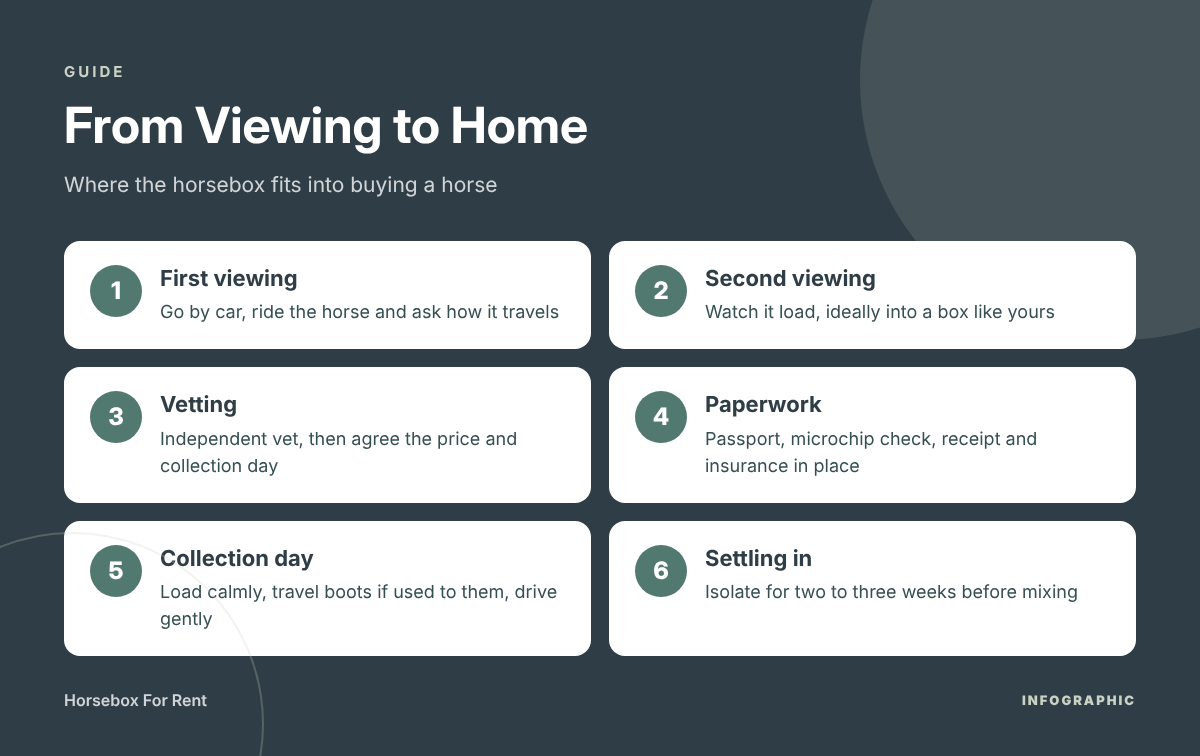
For a first viewing, usually not. You’re there to see the horse, ride it and ask questions, so a car is fine.
A second viewing is different. This is your chance to see how the horse loads and travels, and that’s information you can’t get from an advert.
Watch the horse load
Ask the seller to load the horse while you watch. Ideally, they’d use a box similar to the one you’ll collect in.
If the horse walks straight up, great. If it takes twenty minutes and a lunge line, you need to know that before collection day, not during it.
Ask the right questions about travel
- Does the horse travel in a box, a trailer or both?
- Which way does it face, and does it prefer a particular stall?
- Has it ever scrambled, kicked or panicked while travelling?
- When did it last travel, and how far?
- Does it travel better with a companion?
- Is it used to travel boots or bandages?
These answers shape the box you hire and how you load on the day.
Timing the box around the pre-purchase vetting
A pre-purchase vetting is a thorough examination by a vet acting for you, the buyer. Always use an independent vet, not the seller’s own.
In the UK, buyers usually choose between a two-stage and a five-stage vetting. A five-stage examination includes a period of strenuous exercise, usually ridden, and typically takes a few hours. A blood sample is often taken and stored, so it can be tested later for drugs that might mask a problem.
Don’t book the box for the vetting itself
It’s tempting to vet in the morning and collect in the afternoon. However, if the vetting raises a concern, you’ll want time to think, talk to the vet or renegotiate.
Instead, book the box for an agreed collection day after the vetting. As a result, there’s no pressure to load a horse you’re not yet sure about.
Agree the collection plan with the seller
Confirm the date, time and who will help with loading. Also agree that the horse will be ready, with its passport, when you arrive.
The paperwork before the horse leaves
Paperwork is the part buyers most often forget. Yet it matters legally and practically, so sort it before you set off.
| Document or task | Why it matters | When to sort it |
|---|---|---|
| Horse passport | It must travel with the horse and pass to the new owner | Hand over on collection day |
| Microchip check | The chip should match the passport, and all horses in England must be chipped | At the vetting or on collection |
| Ownership update | The new owner must update the passport details, normally within 30 days | After you get home |
| Receipt or bill of sale | Proof of what you bought, for how much and on what terms | On payment |
| Vetting certificate | Your record of the horse’s condition at purchase | From your vet after the vetting |
| Horse insurance | Covers the horse from the moment it’s yours | Before the journey home |
GOV.UK sets out the horse passport rules, including how to update ownership. Check the details for your passport issuing organisation too.
If the horse comes on trial first
Some sellers allow a trial at your yard before the sale completes. In that case, you’ll need the box twice: once to bring the horse home and once if it goes back.
Put the trial terms in writing. Agree how long it lasts, who insures the horse, who pays any vet bills and what condition it must return in.
Insurance for the journey
Hire insurance, which is included on every hire with us, is designed around the vehicle. Your new horse, however, needs its own cover.
So arrange horse insurance to start before collecting a new horse, not the day after.
Choosing the right box for collecting a new horse
An unfamiliar horse needs a box that suits its size and makes loading as easy as possible. So think about space, payload and licence.
- A 3.5t box drives on a standard car licence and suits one or two horses. It’s ideal for most collections.
- A 5t or 7.5t box needs C1 entitlement. It offers more weight capacity if you’re taking a companion or a large horse.
- Space matters. An anxious horse loads more willingly into a box that feels open and light. Ask us about the stall width and the ramp.
Should you take a companion horse?
A calm companion can help a nervous horse load and travel. However, the two horses don’t know each other, and they may squeal or kick.
If you do take one, make sure the box has a solid partition and the payload covers both horses. Many buyers find a calm person matters more than a companion horse.
Bringing your new horse home?
Tell us the horse’s size and where you’re collecting from, and we’ll suggest the right box. Insurance is included, and every box is cleaned and safety-checked before each hire. Call or WhatsApp 07450 483941.
Collecting a new horse on the day: step by step
Plan the day so nobody is rushing. Collecting a new horse goes best when the seller’s yard is calm and you have time to spare.
- Collect the box early and ask any questions at the handover.
- Arrive at the seller’s yard on time, and park on level ground with room to lower the ramp.
- Check the passport and confirm the microchip matches, if it hasn’t already been checked.
- Ask for a few days’ feed and hay the horse is used to. Sudden diet changes can upset the gut.
- Let the person the horse knows best load it, if the seller is happy to.
- Drive gently, especially for the first few miles while the horse finds its balance.
Travel boots or not?
Use travel boots or bandages only if the horse is used to them. A horse wearing boots for the first time may kick out, so ask the seller. If in doubt, brushing boots or nothing at all may be calmer.
On the road
Brake early, corner slowly and avoid sudden changes of speed. Also stop if you hear repeated scrambling, and check the horse when it’s safe to do so.
Buying from further away
Many buyers travel well beyond their home county to find the right horse. Collecting a new horse from a long way off needs extra planning.
Plan the route and the breaks
Choose main roads where possible, and plan breaks every few hours. Offer water at each stop and check the horse for sweating or signs of stress.
Consider a longer hire
If the round trip is a long one, a single day can be tight. Ask about a weekly booking, which gives you time to drive out, collect calmly and return without rushing.
Know when to use a professional transporter
For very long journeys, a professional transporter may be the better option. They’re used to long-distance welfare and the rules that apply to commercial animal transport.
Settling your new horse in at home
The journey ends at your yard, but the job doesn’t. The first few weeks set the tone for your partnership.
Isolate before mixing
Keep your new horse separate from the others for around two to three weeks. That reduces the risk of spreading infections such as strangles.
During isolation, use separate buckets, haynets and grooming kit. Also handle the new horse last each day, and wash your hands afterwards. Your vet may suggest a strangles blood test too.
Introduce slowly
After isolation, introduce your new horse to one calm companion over a fence first. Then build up to turnout with others gradually.
Change feed gradually
Use the seller’s feed and hay for the first few days. Then mix in your own over a week or two, so the gut adjusts.
For more advice on buying and settling a horse, World Horse Welfare offers free guidance.
Buyers based around Much Hadham and Hoddesdon often collect from right across East Anglia and beyond. Giving yourself a full day for collection is usually wise.
Common mistakes when collecting a new horse
Most collection-day problems are avoidable. Here are the ones we’d most like you to sidestep.
- No plan B for loading. Agree with the seller that, if the horse won’t load calmly, you can come back another day.
- Guessing the horse’s weight. A big horse plus a companion can exceed a small box’s payload, so tell us the details.
- Forgetting what’s included in the sale. Check whether tack, rugs or a passport holder come with the horse, and pack them.
- Driving an unfamiliar box for the first time with an unfamiliar horse. If you’re new to horseboxes, have a short practice drive empty first.
- Rushing home to meet the herd. Isolation comes first, however excited everyone is.
In short, slow down. Collecting a new horse is a once-in-a-while event, so give it the whole day it deserves.
Quick answers
Should I bring a horsebox to a first viewing?
Usually not. Bring one to a second viewing if you want to test loading, or on collection day.
When should I book the box for collecting a new horse?
Book it once the vetting is done and you’ve agreed the collection day with the seller.
What paperwork must travel with the horse?
The passport, which should pass to you as the new owner. Update the ownership details afterwards, normally within 30 days.
Can I drive the box on a car licence?
Yes, for a 3.5t box. Our 5t and 7.5t boxes need C1 entitlement.
How long should a new horse be isolated?
Around two to three weeks is a common recommendation. Ask your vet for advice for your yard.
A calm start to a new partnership
The best way of collecting a new horse is a well-planned one. Watch the horse load before you commit, vet independently and book the box for an agreed day afterwards.
Then sort the paperwork, drive gently and isolate on arrival. You’ll find every option on our services page, plus answers in our FAQ and the areas we cover.
Book your collection day
Daily, weekly or monthly hire with insurance included and a clear, fixed quote. We’re open 8:00–18:00, seven days a week. Call 07450 483941 to check availability.