


Call us: 07450 483941


Your first competition trip with a hired horsebox starts well before show morning. The box has to be booked, collected, packed and driven, all around a fixed class time.
None of that is difficult. However, it’s far easier in the right order, with a little slack built in.
This guide follows the whole trip, from choosing the hire length to handing back the keys. It’s written for riders in Essex, Suffolk, Cambridgeshire and Hertfordshire, but the method works anywhere.
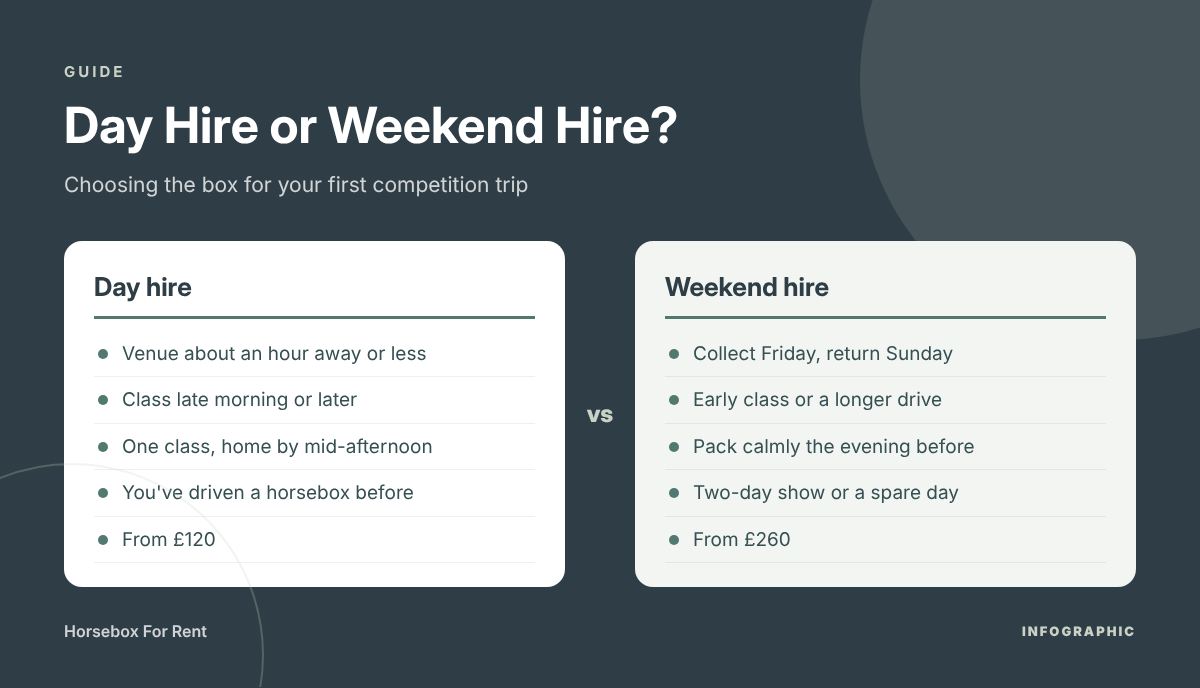
Day or weekend hire for your first competition trip?
The first decision is how long to keep the box. It looks like a price question, but it’s really about pressure on the day.
With day hire, collecting the box is the first job of show morning. Returning it is the last job of a long day. Weekend hire moves both jobs away from the show.
| Day hire | Weekend hire | |
|---|---|---|
| Guide price | From £120 | From £260 |
| Hire period | One day | Collect Friday, return Sunday |
| Best for | A local show and a late-morning class | An early class, a longer drive or a two-day show |
| When you pack | On show morning | Calmly, the evening before |
| Show-day pressure | Higher: collection and return bookend the day | Lower: the box is already at your yard |
Your exact quote depends on the box size and dates, and we confirm it clearly before you book. Insurance is included on every hire.
When a single day is enough
- The venue is roughly an hour or less from your yard.
- Your class is late morning or later.
- It’s one class, and you’ll be home by mid-afternoon.
- You’ve driven a horsebox before.
For example, a rider near Sawbridgeworth heading to a show just over the Essex border is classic day-hire territory.
When the weekend earns its keep
Book the weekend if your class is early, the drive is long or the show runs over two days. It also suits a nervous first-timer: you can pack on Friday and practise driving the empty box.
If you then start competing most weekends, our guide to long-term horsebox hire for the competition season explains when monthly hire makes sense.
Match the box to your licence and horses
Our 3.5t boxes drive on a standard car licence and suit one or two horses or ponies. The 5t and 7.5t boxes need C1, which most drivers who passed before 1 January 1997 already hold.
Unsure what yours covers? Read our guide to horsebox licence rules for B, C1 and C1E before you book.
Your first competition trip countdown: two weeks to show morning
A first competition trip usually goes wrong in the gaps between jobs: a missed entry date, a forgotten passport, a box booked for the wrong day. A simple countdown closes those gaps.
| When | Horse and entries | The hired box | You and your kit |
|---|---|---|---|
| 2 weeks out | Enter; check passport and vaccinations | Book day or weekend hire and the box size | Check your licence and horse insurance |
| 1 week out | Practise loading; plan any companion | Confirm collection and return times | Plan the route and reverse timetable |
| Day before | Groom, plait and fill haynets | Weekend hire: collect, check and pack | Fill water, lay out clothes, charge phone |
| On the day | Feed early, travel gear on, load calmly | Walk round the box before leaving | Leave 20–30 minutes spare |
Summer weekends tend to be the busiest time for horsebox hire. So for a show between May and September, book the box as soon as your entry is in.
Read the schedule properly
Check the entry deadline, class times, heights or levels, and any dress or tack rules. For affiliated classes, the British Showjumping website explains the membership and horse registration you’ll usually need first.
That said, unaffiliated shows at riding clubs and equestrian centres make a gentler start, and East Anglia has plenty.
Collection and handover: ten minutes well spent
Treat the handover as part of your first competition trip, not a formality. Every box is cleaned and safety-checked before your hire, and the walkthrough shows you how this one works.
What to check before you drive away
- The ramp. How to lower and raise it safely.
- Partitions and breast bar. How they open, pin and lock.
- Tie rings. Where they are, inside and out.
- Lights, mirrors and wipers. Set the seat and mirrors before moving off.
- Fuel. The level now, and the level to return it at.
- Existing marks. Photograph any scuffs, so the return check is simple.
- The height. Know it for car park barriers.
Also ask who to call if anything goes wrong on the road. A refundable security deposit is taken when you book, so confirm how the return check works.
If the box is new to you, drive a short loop with no horse on board. Get a feel for the brakes, width and mirrors first.
Got a show date in the diary?
Tell us your show date, class time and number of horses, and we’ll suggest day or weekend hire. Insurance is included and every box is safety-checked first. Call or WhatsApp 07450 483941.
A reverse timetable for show day
The most useful thing to write before a first competition trip is a reverse timetable. Start from your time in the ring, then work back through every job.
Here’s an example: an 11:15 show jumping class, 50 minutes away, with the box already at your yard on weekend hire.
- 11:15 – Into the ring. The only fixed point.
- 10:45 – Warm up. Typically 25–30 minutes; practice fences get busy.
- 10:15 – Walk the course, if it’s open. A helper holds your horse.
- 9:50 – Tack up. Boots, saddle, bridle and number.
- 9:30 – Arrive and park. Collect your number and check timings.
- 8:20 – Leave the yard. Fifty satnav minutes becomes roughly 70.
- 7:50 – Load. Allow 30 minutes for a hesitant horse.
- 7:15 – Final checks. Travel boots on, water and haynet aboard.
Why add a third to the drive? With a horse on board, you brake earlier, corner slower and take roundabouts gently.
On day hire, add the collection to the top of the plan. Count the drive there, the handover and moving your kit across. That’s often why an early class tips the balance towards the weekend.
Finally, keep a spare 20–30 minutes. Riders near Bishop’s Stortford heading up the M11, or anyone on the A12 or A14 on a summer Saturday, know how fast traffic swallows it.
Packing the box for your first competition trip
A hired box doesn’t come with your own system of hooks and lockers. So decide where things go before loading, and stick to it.
Pack in reverse order of use
What you need last goes in first and furthest away. Arrival kit, such as a headcollar, haynet and water bucket, sits nearest the door.
Use lidded crates rather than loose bags: one for grooming, one for tack and one for the rider. They stack, don’t spill and are easy to search.
Respect the payload
Every box has a maximum weight, and a 3.5t box has little to spare once a horse is aboard. Water is heavy: a full 25-litre container weighs about 25kg.
Keep heavy items low and secured, and nothing loose in the horse area. A sliding crate can frighten or injure a horse under braking.
The short packing list
- Passport, which should travel with your horse
- Headcollar and lead rope, plus a spare of each
- Water containers, two buckets and a filled haynet
- Travel boots or wraps and a rug for the weather
- Saddle, bridle, girth, boots and studs if you use them
- Grooming kit, fly spray and an equine first aid kit
- Hat, show clothes, gloves and boots in a hanging bag
- Muck skip, shovel and broom for the box
- The schedule, a phone charger and some cash
Taking a companion horse on your first competition trip
Some horses travel and compete happily alone. Others fret the moment their field-mate disappears, and a companion can calm them.
Check the box and the weight first
Two big horses plus kit and water can use up a 3.5t payload quickly. So tell us both horses’ sizes when you book, and we’ll suggest the right box.
Loading and unloading
Load the calmer horse first, so the nervous one walks up towards a friend. When unloading, have one person per horse and don’t rush.
The companion needs a plan at the venue too
Someone has to stay with the companion while you ride. A horse left alone can panic when its friend heads to the ring.
The companion also needs its own passport, haynet and travel gear. In short, pack for two horses, not one and a half.
At the venue: parking, tying up and water
The lorry park is where a first competition trip feels most chaotic. Fortunately, a simple routine keeps everyone settled.
Parking the box
- Follow the stewards. They’re placing boxes so everyone can get out.
- Choose firm, level ground with room to lower the ramp fully.
- Point the ramp away from traffic where you can.
- Avoid soft patches in wet weather. Heavy Essex clay can bog a box down.
- Note where you parked. Rows of boxes look identical later.
Tying up safely
Tie your horse to an outside tie ring with a quick-release knot. Many riders tie to a loop of baling twine, which breaks first if the horse pulls back.
Hang the haynet high so an emptying net can’t catch a leg. Leave a gap from neighbouring horses, and never leave a tied horse unattended.
Water and shade
Bring water from home. Plenty of horses refuse unfamiliar water, and venue taps may be busy or far away.
Offer a drink on arrival, between classes and before leaving. On hot days, open the vents and never leave a horse shut in a box in the sun.
The British Horse Society also has plenty of horse care and safety advice worth reading first.
Coming home and returning the box
The journey home is when tired riders make mistakes. So take 15 minutes before loading to run a proper check.
- Horse cool, dry and offered water
- Travel boots or wraps back on
- Ramp, partitions and breast bar secured
- Nothing left under or beside the box
Then drive home at least as gently as you drove there. A tired horse finds braking and bends harder to balance through.
Back at the yard
Unload, check your horse’s legs and let them settle. Then muck out while the bedding is fresh, because dried-on droppings take far longer to shift.
Our step-by-step guide on how to clean a horsebox before you return it covers the full routine.
Handing it back
Return the box at the agreed time and place, with fuel at the agreed level. Fuel is separate from the hire, so fill up on the way back.
Finally, mention anything that happened during the hire, however small. An honest note keeps the handover simple and helps the next rider.
Quick answers
How far ahead should I book a horsebox for my first competition trip?
Two weeks is a sensible minimum. For summer weekends, book as soon as your entry is confirmed.
Should I choose day hire or weekend hire?
Day hire suits a local show with a late-morning class. Weekend hire, collected Friday and returned Sunday, suits early classes, longer drives and two-day shows.
Can I drive a 3.5t horsebox on my car licence?
Yes, a full UK car licence covers our 3.5t boxes, while the 5t and 7.5t boxes need C1. Every driver also needs to meet our age, experience and insurance requirements.
Is fuel included in the hire?
No, fuel is separate. Insurance, however, is included on every hire.
Do I need to take a companion horse?
Only if your horse is unsettled on its own. If you do, plan for someone to stay with the companion while you ride, and pack its passport.
Your first outing, sorted
A first competition trip with a hired box comes down to three things done early: the right hire length, a reverse timetable and a packed box. Get those right, and the day has room for nerves or a traffic jam.
Compare every hire option on our services page and check the areas we cover across Essex and East Anglia. Or send your show date via our contact page.
Book the box for your first show
Send us your show date, class time and the horses travelling for a clear day or weekend hire quote. We’re open 8:00–18:00, seven days a week. Call or WhatsApp 07450 483941.